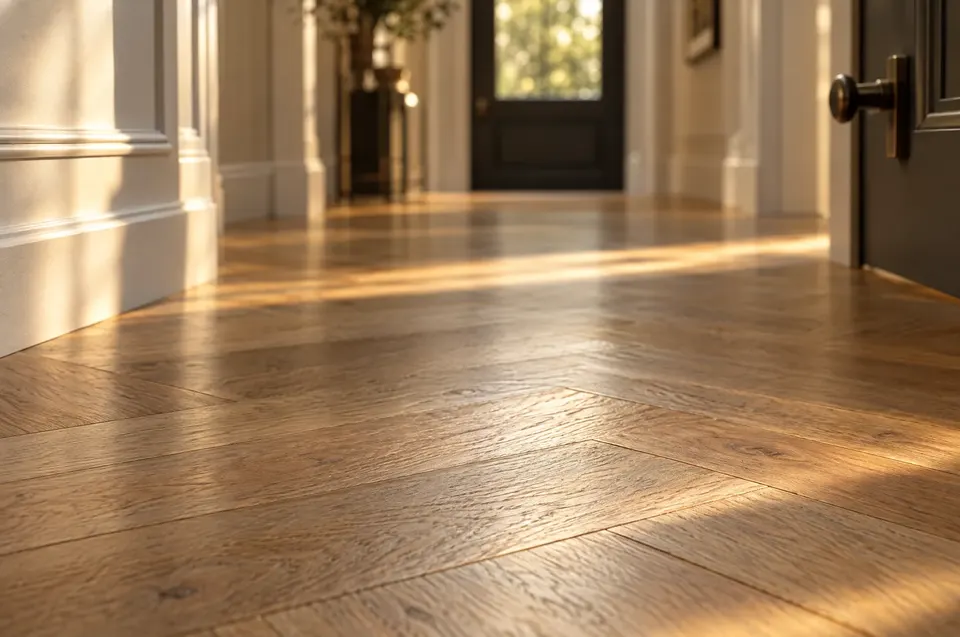
A herringbone floor is laid out from the center of the room
We find the center of the room and snap a line down it. The first rows get glued to a straight guide along that line, and every row after is checked back to it. Walls in older houses are seldom parallel, so centering on the room keeps the pattern square where you look at it.
Borders and custom inlays in walnut or oak
A pattern field with a border looks finished at the walls. A single band of straight flooring running around the room makes the field look intentional. A walnut border inside a white oak field or a feature strip down a hallway uses a contrast species cut on the same lines as the field, so the floor reads as one surface.
What our herringbone and chevron floor work includes
- Layout snapped from the room center so the pattern sits square
- Every row checked back to the center line
- Borders and inlays in walnut or a second oak grade
How a herringbone or chevron floor gets laid
- STEP 1
Drawing the pattern
We measure the room and draw the layout so you see it before any wood is ordered.
- STEP 2
Ordering and culling
Pattern stock comes from one run, and we cull blocks that bow.
- STEP 3
Center lines and the first rows
We snap the center line and glue the first rows to a straight guide.
- STEP 4
Borders, sanding and finish
The border goes in last. A site-finished field is then sanded flat and finished with the rest of the floor.
What moves the cost of a herringbone or chevron floor
Pattern work costs more than a plank floor in the same room, and the gap comes from labor and waste. Chevron takes longer than herringbone because of the angled ends.
- Herringbone or chevron
- Block size and the total piece count
- Borders, contrast bands and inlays
- Room shape and doorways
Herringbone and chevron floor questions
What is the difference between herringbone and chevron?
Herringbone blocks have square ends and sit at ninety degrees to each other, so the pattern has a stepped zigzag down its center. Chevron blocks have angled ends, so they meet at a point and form a clean V with a straight center seam.
Does a herringbone floor cost more than a plank floor?
Yes, for the same room, because of the labor and the waste. Every block is placed and checked by hand, and the perimeter is cut on a diagonal. The gap narrows in a small entry and widens across a great room.
Can you lay herringbone over in-floor heat?
Yes, in engineered blocks glued down, with the heating system run before the install. The short blocks and the plywood core together move little, so a pattern floor over radiant tends to behave well.